
.avif)
Short answer: yes, for most couples it is. When photo and film come from one team that works together throughout the day, you end up with a record of your wedding that feels like a single story — not two separate assignments that happened to take place on the same afternoon.
That is not just a sales line. It is a matter of logistics. A wedding day rarely offers a second chance at a moment. The first look, the best man's speech, the first dance — each of these happens exactly once, often in different corners of the room, at the same time. When a photographer and videographer already know each other, communicate, and know where the other is standing, nothing gets missed, and no one ends up in the other's shot.
Why I offer photo and film as one team
Since I started photographing weddings in 2016, the way I think about a wedding day has changed. A day is not a series of separate photo moments — it is one continuous story with a beginning, a middle and an end. Across more than 270 weddings, I have seen how much easier it is for a couple when that story is told by a team that has already aligned on the schedule, the light, the positioning, and what actually matters to capture.
With separately booked providers, the coordination usually falls on the couple — two contracts, two timelines, two teams meeting for the first time on the wedding day itself. That can work, but it tends to create friction exactly where there is the least room for it.
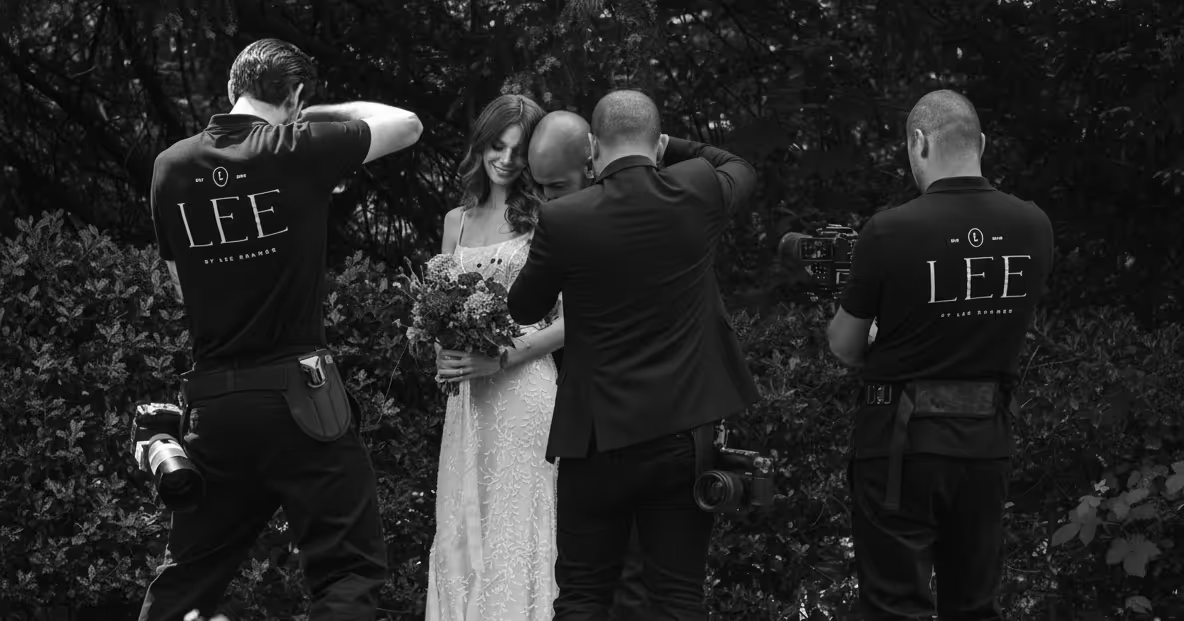
One coordinated team, one continuous story
The reason I believe in this more than anything else
Here is the part I care about most, and it has nothing to do with logistics.
Our daughter was not yet born when my wife Anna Maria and I got married. She did not exist on that day. And yet today, she asks to watch our wedding film almost every week. She has never once asked to look through the photo album on her own — but the film, she returns to again and again. She has grown up half-knowing the version of her parents who existed before she did, simply because it was filmed.
That is the part couples rarely think about when they are deciding whether to add video to their day. A wedding film is not really for the two of you. Not primarily. It is for the people who were not there yet — your children, and one day, theirs. Photos tell them what the day looked like. A film lets them hear your voices, watch you laugh, see how you looked at each other before they existed. That is a completely different kind of gift, and it is one that becomes more valuable with every year that passes, not less.
Our daughter was not even born on our wedding day. Today she watches our wedding film every week. That, to me, is the entire argument for why video matters.
What you get when both come from one source
The most practical benefit is time saved in planning. Instead of coordinating two proposals, two timelines and two separate briefings, there is one point of contact who knows the full schedule of the day and directs the photo and film team accordingly. That takes real pressure off the final weeks before the wedding, when everything else is already converging at once.
The second benefit is stylistic. Photo and film from one source share the same visual language — the same sense of color, the same instinct for light, the same understanding of which moments matter. What you get at the end is not two differently told versions of your day, but one shared memory in two formats.
When booking separately can still make sense
Honestly, there are situations where combining the two is not essential. Couples who choose a very small, private ceremony without film, or who already have a videographer from within their own circle who means a great deal to them personally, do not need to combine services. A tighter budget can also be a reason to focus on one of the two first.
In those cases, I would still recommend raising it openly in advance — that way the day can be planned so an external video team is properly integrated, rather than meeting everyone for the first time on the wedding day itself.